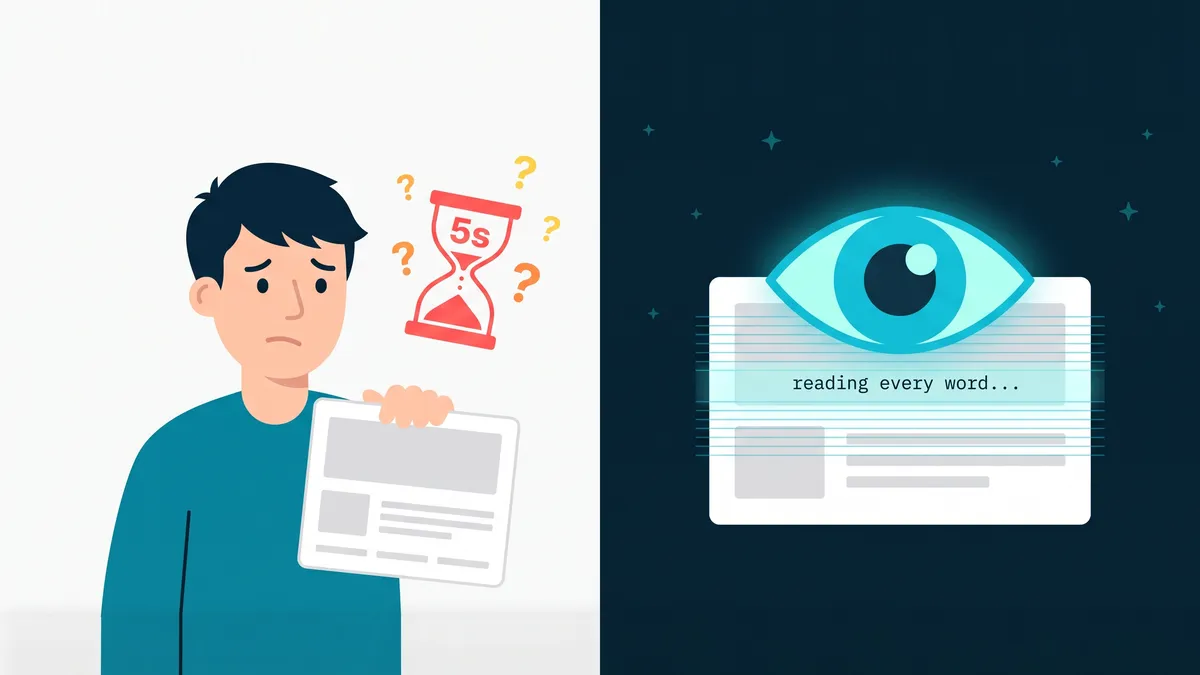
You have a website. It loads fast, looks fine — but you're still struggling to get clients. The instinct is to blame the tech. But in most sites we audit, the website works exactly as built. What's broken is the message. And in 2026, a broken message costs you twice — because your homepage now has two readers.
Why isn't my website converting?
Direct answer: most websites don't have a design problem — they have a message problem.
The average website converts just 2.35% of visitors; 97 out of 100 people leave without taking action (GreetNow, 2026 benchmark report). For service businesses, anything under 1% usually signals the same culprit: visitors can't tell what you do, who it's for, or what to do next.
The data backs this up. One evaluation found roughly 70% of small business homepages lack an appropriate call to action (GoodFirms, via Marketing LTB), and 75% of consumers say they judge a company's credibility by its website (Stanford/web credibility research, widely replicated). Credibility isn't just visual — it's whether your page answers, in seconds, the only three questions a visitor has: What do you do? Is it for me? What next?
Who is actually reading your website in 2026?
Direct answer: two readers — humans and AI — and both read your message, not your design.
The first reader is human: a visitor who gives you about five seconds before deciding to stay or leave.
The second reader is new. Roughly 37% of consumers now begin their searches with AI tools instead of a traditional search engine (Eight Oh Two study, 2026), and ChatGPT alone processes around 2.5 billion prompts per day (OpenAI, 2026). Gartner projected traditional search volume would drop 25% by 2026 as chatbots take over discovery — and that shift is now measurable. When someone asks an AI "who's the best mobile detailer near me?" or "which platform should I use to run my marketing?", the answer is assembled from the plain text on your pages. AI can't infer your services from your hero image or your slider. If your homepage says "Welcome to quality you can trust," you're not just vague to humans — you're invisible to the machines now making recommendations.
How do I test if AI understands my website?
Direct answer: paste your homepage text into a fresh ChatGPT chat and ask it to describe your business. Takes two minutes.
Copy the words off your homepage. Just the text — select all, copy. No screenshots.
Open a fresh ChatGPT chat. Fresh matters: no history, no context, no mercy — exactly how AI sees you when a stranger asks for recommendations.
Paste and ask: "Based only on this text: what does this business do, who is it for, and why should someone choose them?"
How to read your result:
Confident, accurate, specific — "This company details cars at the customer's home, targets busy professionals, finishes in 90 minutes." Your message survives machine reading.
Hedging — "This appears to be some kind of service business, possibly offering..." The AI is guessing. A guessing AI doesn't recommend you; it recommends the competitor it understands.
Wrong — wrong services, wrong audience, or a shrug. You're invisible to the fastest-growing referral channel there is.
Here's the uncomfortable part: the machine read every word on your page and still couldn't tell what you do. A human gives you five seconds and reads almost nothing. If the machine fails, the human failed long ago.
What happens if AI can't understand my site?
Direct answer: you lose the highest-intent traffic channel that exists right now.
An analysis of 177 brands across three industries found 90% had zero AI search mentions (Search Engine Journal, May 2026) — meaning when customers ask AI for recommendations, nine out of ten businesses simply don't exist in the answer. Meanwhile, the businesses that do show up win disproportionately: visitors referred by ChatGPT convert at around 16%, versus 1.8% for Google organic traffic — nearly nine times higher (Seer Interactive case study). Brands recommended by ChatGPT are 2.5x more likely to receive a site visit within seven days, and AI-referred visitors view nearly twice as many pages and stay twice as long (Similarweb, June 2026).
Small volume today, outsized intent — and it compounds. The message you fix now is the recommendation you win next year.
That's 1 of 5 checks
The AI test is the newest check we run on a website's message — and the most fun to fail. The other four score what your human reader decides in those five seconds: whether they get it, believe it, and act on it. Interested in running your website through this tool? Give us a shout.
FAQ
What is a good conversion rate for a small business website?
Most small business websites convert between 2% and 5% of visitors. If you're under 1%, the most common cause isn't traffic or design — it's an unclear message and a weak call to action.
Does AI really send customers to websites?
Yes. About 37% of consumers now start searches with AI tools, and AI-referred visitors convert at roughly 16% — nearly 9x the rate of traditional organic search traffic (Seer Interactive).
How do I make my website readable by AI?
State in plain text what you do, who you serve, where, and why you're credible. AI systems assemble recommendations from your page text — they can't read images, sliders, or vague taglines. Our Rate Your Website tool checks this automatically.
Do I need a redesign to fix my message?
No. Message fixes are the cheapest fixes in marketing: rewrite the headline, replace adjectives with outcomes, and give the page one clear call to action. Most owners can do it in an afternoon.