Every owner asking this question has been burned before. Some "simple" tool promised easy, and by Sunday night there was a half-finished site, forty open tabs, and a subscription you'd pay for eleven more months out of guilt. So it's the right question to ask — and it deserves a real answer with timestamps, not a landing-page promise.
How long does a business website normally take to build?
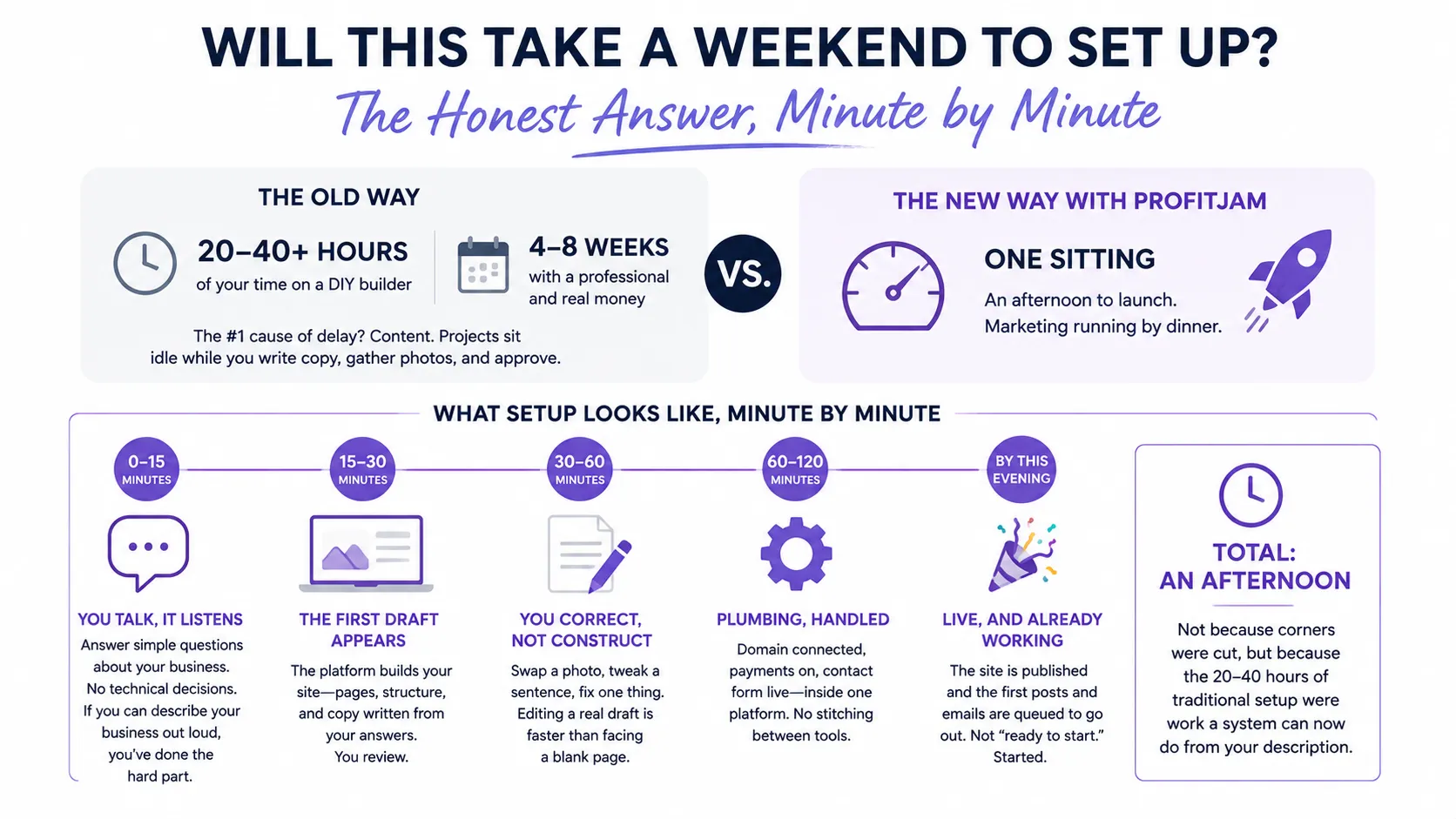
Direct answer: 20–40+ hours of your time on a DIY builder, or 4–8 weeks and real money with a professional.
The benchmarks are consistent across the industry: a standard small business website takes about 20–40 hours of design and development work, and professional builds typically run 4–8 weeks end to end — often 30–60 days from kickoff to launch (web industry analyses, 2025–2026). DIY on a traditional page builder lands in the same 20–40 hour range, except the hours are yours, spread across evenings and the infamous lost weekend.
And here's the detail buried in every agency's timeline: the single biggest cause of delay isn't design or code — it's content. Projects sit idle for weeks waiting on the owner to write the copy, gather the photos, and approve the words. Which reveals what the weekend actually gets eaten by.
Why does "simple" always turn into a lost weekend?
Direct answer: because the tool was never the hard part — the blank page was.
Traditional builders solved the technology and handed you the real work: What should the headline say? Which pages do I need? What do I write about my services? A drag-and-drop editor with empty boxes is just a prettier blank page, and every empty box is a decision. Forty small decisions is a Saturday.
That's why the classic weekend ends with a half-finished draft. You didn't run out of software skill; you ran out of answers. The setup that respects your time isn't the one with the smoothest editor — it's the one that stops asking you to be the copywriter, designer, and information architect of your own business.
What does setup look like when the platform does the work?
Direct answer: one sitting — here's the honest minute-by-minute.
Minutes 0–15: You talk, it listens. You answer plain questions about your business — what you do, who it's for, where you operate, what makes you worth calling. No technical decisions. If you can describe your business out loud, you've done the hard part.
Minutes 15–30: The first draft appears. The platform assembles the site — pages, structure, copy written from your answers, not lorem ipsum. Your job shifts from creating to reviewing, which is a fundamentally faster job.
Minutes 30–60: You correct, not construct. Swap a photo, sharpen a sentence, fix the one thing it got wrong about you. Editing a real draft takes a fraction of the time facing an empty box does.
Hour 1–2: Plumbing, handled. Domain connected, payments switched on, contact form live — inside the same platform, so there's no stitching between a host, a builder, and a processor.
By this evening: Live, and already working. The site is published and the first marketing — posts, emails — is queued to go out. Not "ready to start marketing." Started.
Total: an afternoon. Not because corners were cut, but because the 20–40 hours of traditional setup were mostly work a system can now do from your description.
What's the honest catch?
Direct answer: you still make the calls — you're just not doing the labor.
No serious platform removes you from setup: the review pass is real, your standards apply, and the first draft won't be perfect. What it removes is the labor between decisions — the writing, the layout-fighting, the plumbing. Answering questions about your own business is work you can do tired on a Tuesday. Building pages is not.
That's the test we built ProfitJam to pass: setup that finishes in one sitting and marketing that's already running by dinner — because the businesses that never launch aren't lazy, they just never got a free weekend. Want to time it yourself? Give us a shout.
FAQ
How long does it take to build a small business website?
Traditional routes take 20–40+ hours DIY or 4–8 weeks with a professional. AI-assisted platform builds compress this to a single sitting because the copy, structure, and design are generated from your description rather than assembled by hand.
What slows down website projects the most?
Content. Industry analyses consistently find that waiting on copy, photos, and owner approvals delays projects more than any design or technical step — which is why platforms that generate the first draft launch dramatically faster.
Do I need technical skills to set up an all-in-one platform?
No. Setup is answering plain-language questions about your business. If you can describe what you do and who you serve, the platform handles the pages, hosting, domain, and payment wiring.
What should I have ready before starting setup?
Three things: a clear one-paragraph description of what you do and for whom, a logo or a few photos if you have them, and your domain login if you already own one. Everything else can be generated or added later.