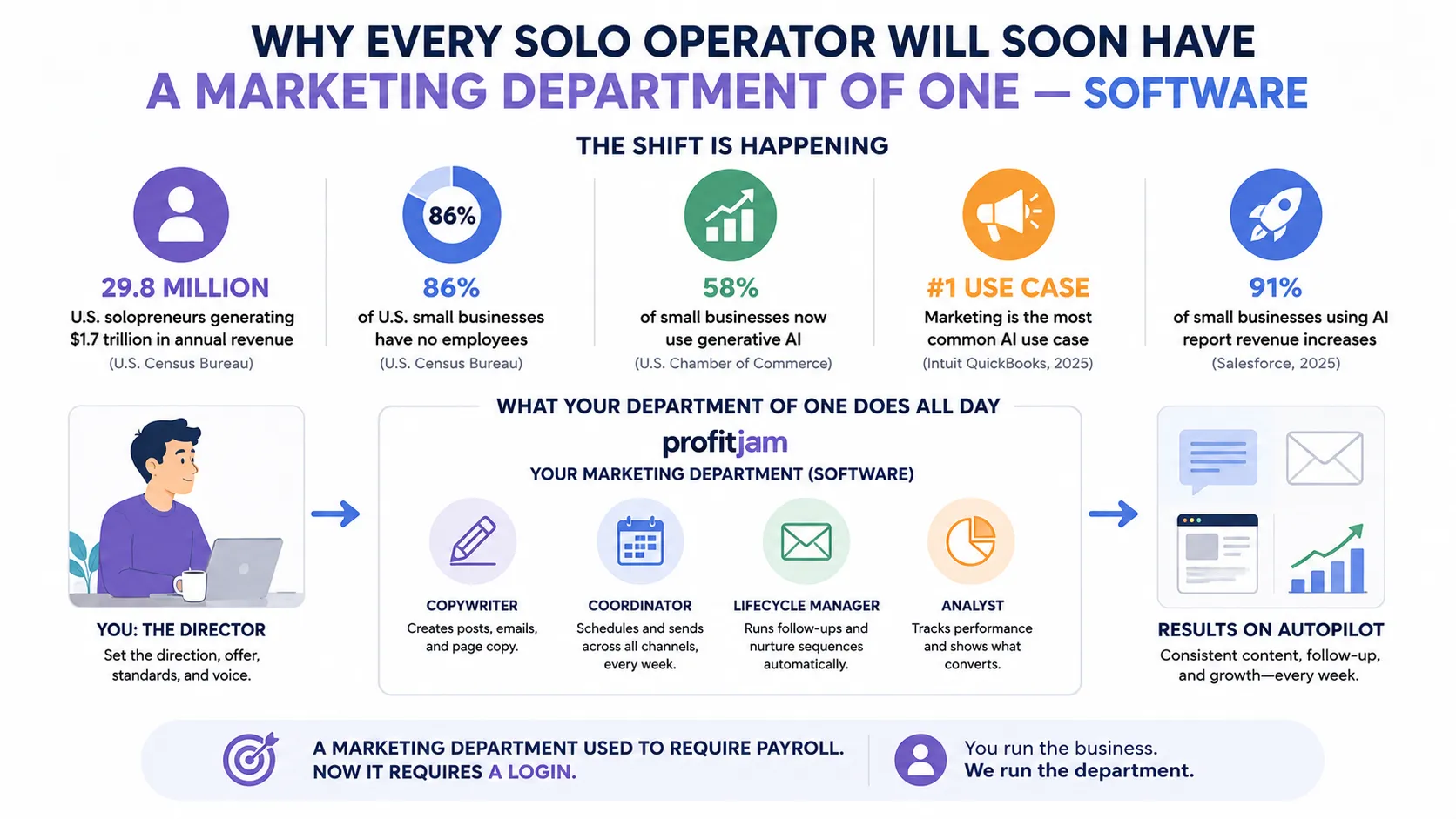
A marketing department used to be a payroll decision. Copywriter, designer, someone to run the emails — headcount that only companies with real budgets could justify, while the solo operator did all three jobs at 10pm or did none of them. That dividing line — companies that can afford marketing versus owners who do it themselves — is dissolving right now, and the data shows exactly how.
Can a one-person business really have a marketing department?
Direct answer: 29.8 million American businesses are about to find out — because solo is now the default, not the exception.
The U.S. has roughly 29.8 million solopreneurs generating $1.7 trillion in annual revenue (U.S. Census Bureau nonemployer statistics), and about 86% of all American small businesses have no employees at all. This is the majority of the business population — and historically, the entire category was locked out of professional marketing. You either bought an agency, hired a marketer, or became one at night.
Software is the third option that never existed before: a department with no payroll, no management overhead, and no Monday standup. Not tools that help you do marketing — a system that does the marketing.
What changed to make this possible?
Direct answer: AI crossed from novelty to workhorse — and the smallest businesses are adopting it fastest.
The adoption curve is steep: 58% of small businesses now use generative AI, up from 40% in 2024 and just 23% in 2023 (U.S. Chamber of Commerce) — a near-tripling in two years. And the pattern within that number is the telling part. Marketing is the single most common small-business AI use case (Intuit QuickBooks, 2025). Micro-firms with under five employees over-index on adoption compared to mid-sized companies (U.S. Census / SBA) — the businesses with the least headcount are reaching for the substitute first. And marketing automation is the one software category where small firms out-adopt large enterprises (U.S. SBA Office of Advocacy, 2025).
None of that is coincidence. AI's value is proportional to the work you can't hire for — and nobody has more unhireable work than the owner doing everything alone.
Does the software department actually perform?
Direct answer: the adopters are separating from the pack — measurably.
Among small businesses using AI, 91% report revenue increases and 90% report more efficient operations (Salesforce, 2025). More striking is the split by trajectory: 83% of growing SMBs have adopted AI, versus 55% of declining ones (industry analysis, 2025–2026). Adoption doesn't guarantee growth — but the growing and the shrinking are increasingly on opposite sides of the same decision, and the gap widens every quarter the tools improve.
The competitive implication for a solo operator is blunt: your rival isn't the other one-person shop anymore. It's the one-person shop running a department.
What does a department of one actually do all day?
Direct answer: the execution layer — everything a junior marketing team would produce — while you keep the one job software can't take.
Concretely, the software department covers the roles you'd otherwise hire: the copywriter (posts, emails, page copy generated from your business), the coordinator (scheduling and sending across channels, every week, including your buried ones), the lifecycle manager (follow-ups and nurture sequences that fire on behavior, not memory), and the analyst (what ran, what converted). What stays yours is the head-of-marketing job: the offer, the standards, the voice, the judgment calls — the ten minutes of direction, not the ten hours of production.
That's the org chart ProfitJam ships: you as the director, the platform as the department, configured once from a description of your business and running whether or not you showed up to marketing this week. The era where a marketing department required payroll is ending; the era where it requires a login has started. Want to see what your department of one would produce in its first week? Give us a shout.
FAQ
How many small businesses are using AI for marketing?
Generative AI use among small businesses hit 58% in 2025, nearly triple 2023's 23%, and marketing is the most common use case — the single area where small firms out-adopt large enterprises in automation.
Does AI marketing actually increase revenue for small businesses?
The adopters report so at striking rates: 91% of small businesses using AI say it has boosted revenue and 90% say operations run more efficiently (Salesforce). Growing SMBs adopt AI at 83% versus 55% for declining ones.
Can AI replace hiring a marketer for a small business?
For the execution layer — content production, scheduling, email sequences, follow-up — largely yes, at a fraction of a salary. Strategy, positioning, and brand judgment remain owner work; the software removes the labor between decisions, not the decisions.
What's the difference between AI marketing tools and an AI marketing department?
Tools assist tasks you still perform — a writing aid, a scheduler. A department executes the whole function: it produces, distributes, follows up, and reports without you initiating each task. The distinction is who carries the recurring work.