You post on Instagram because it feels visible. Likes come in, sometimes a comment. Meanwhile the email list you collected — the one sitting in a spreadsheet or a dusty Mailchimp account — goes untouched for months. Here's the uncomfortable math: the channel you keep feeding is the one that pays the least, and the one you keep ignoring is the highest-earning channel in marketing.
Does email really make more money than social?
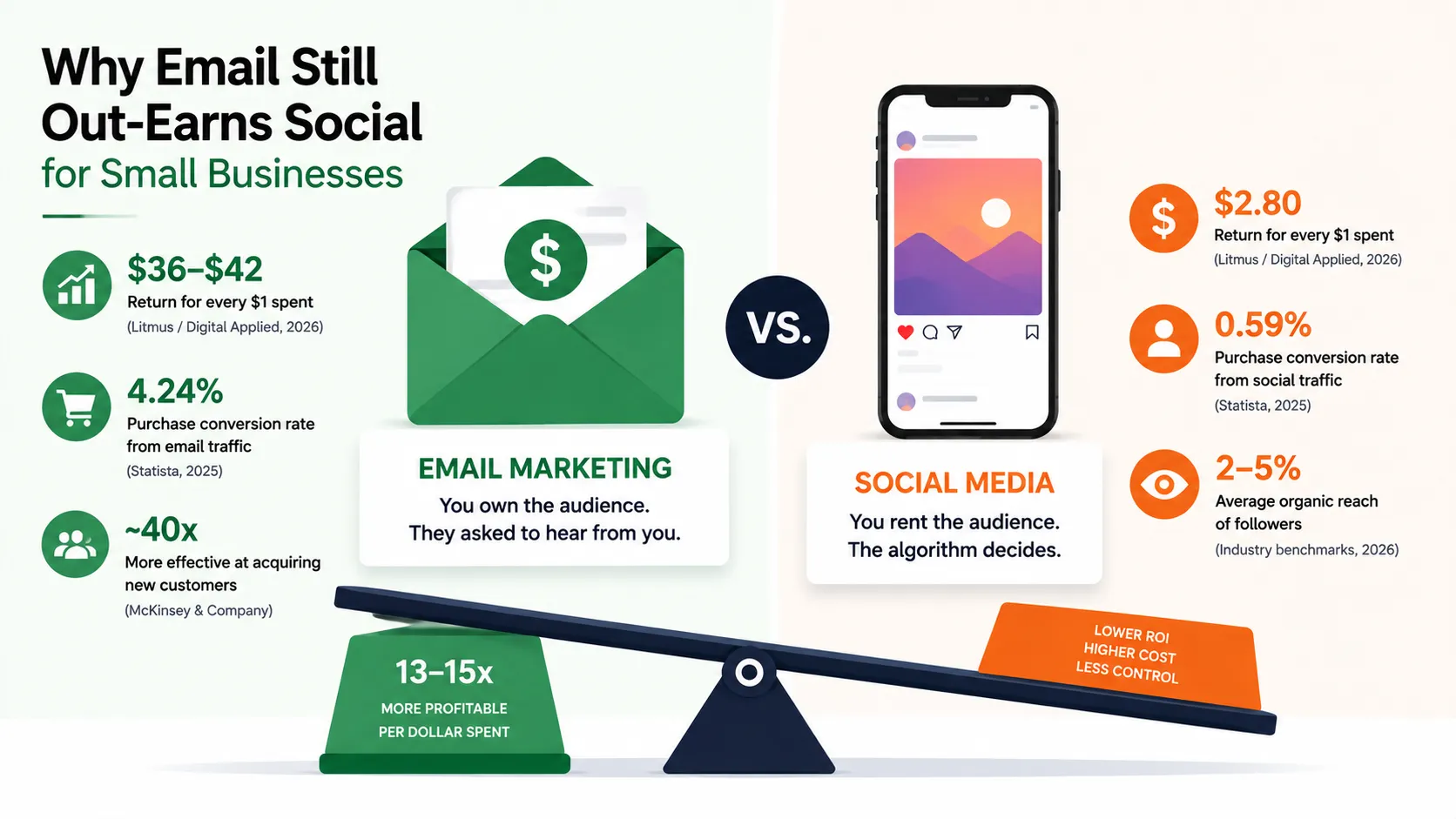
Direct answer: yes — by a wide margin. Email returns $36–$42 for every $1 spent; social advertising returns about $2.80.
The gap isn't close. Email marketing delivers an average return of $36–$42 per dollar spent, compared to roughly $2.80 for social advertising, $2 for paid search, and $1.35 for display ads (Litmus / Digital Applied, 2026). That makes email 13–15x more profitable per dollar than the social ads most small businesses default to.
Conversion data tells the same story from a different angle: 4.24% of visitors arriving from email make a purchase, versus 2.49% from search and just 0.59% from social media (Statista, 2025). And for winning new customers — the thing social is supposedly best at — email is roughly 40x more effective than Facebook and Twitter combined (McKinsey & Company).
Why does social feel better but pay worse?
Direct answer: because you're renting an audience on social and you own one on email.
When you post to your Facebook page, the algorithm shows it to about 2–5% of your own followers (industry benchmarks, 2026 — down from over 15% in 2014). Instagram is similar: the average post now reaches roughly 3.5–7.6% of followers, down from 10–15% in 2020 (Socialinsider). You built that audience, and the platform charges you — in ad spend — to reach it.
Email has no algorithm standing between you and your list. If 500 people gave you their address, your message lands in 500 inboxes. Deliverability isn't perfect, but it's not a 95% toll booth either.
There's a second difference: intent. Someone scrolling social is avoiding work. Someone who typed their email into your form asked to hear from you. About 60% of consumers say email is how they prefer businesses to contact them, and 59% say marketing emails have influenced a purchase (industry surveys, 2025–2026).
How do I test this on my own business?
Direct answer: run the reach math on your last post, then on your list. It takes one minute.
Take your follower count and multiply by 0.05. That's roughly how many people saw your last organic post. 1,000 followers ≈ 50 viewers.
Take your email list size and multiply by 0.35 — a conservative small-business open rate. 1,000 subscribers ≈ 350 readers.
Compare. Same audience size, 7x the eyeballs — and the email readers convert at 7x the rate of social traffic on top of that.
If your list is smaller than your following, that's not an argument against email. It's the gap you should be closing, because every address you capture is reach you never pay for again.
So why doesn't anyone actually send the emails?
Direct answer: because a newsletter is a recurring blank page, and blank pages lose the priority fight every week.
This is the honest reason email lists sit unused: writing an email is a task, and it's the first task cut when a client fire starts. The channel with the best economics loses to the channel with the lowest friction — tapping out a quick post feels easier than facing an empty draft.
That's a solvable problem. The businesses winning with email in 2026 aren't the ones with the most willpower; they're the ones who removed the blank page. Automated emails generate 320% more revenue than manual ones (Campaign Monitor), precisely because they go out whether or not the owner had a free Tuesday. Set up once, the sequence runs — welcome emails alone see open rates near 70%, the highest of any message type.
ProfitJam was built around exactly this: you describe your business once, and the platform writes and sends the emails — alongside the social posts — without you returning to a calendar. The channel that out-earns everything else shouldn't depend on your quietest week. Want to see what your first month of hands-off email looks like? Give us a shout.
FAQ
What is the average ROI of email marketing?
Email marketing returns an average of $36–$42 for every $1 spent, the highest of any digital channel. Social advertising returns about $2.80 per dollar, and paid search about $2 (Litmus / Digital Applied, 2026).
Is email marketing still effective for small businesses in 2026?
Yes. Around 81% of small businesses use email as their primary acquisition channel, and email traffic converts at 4.24% versus 0.59% for social traffic. The advantage has grown as organic social reach has fallen to single digits.
How often should a small business send email?
Once or twice a month is enough to stay top-of-mind without fatiguing your list. Consistency beats frequency — a monthly email that actually goes out earns more than a weekly plan you abandon by March.
Should I stop posting on social media entirely?
No. Social is where new people discover you; email is where they become customers. The mistake isn't posting on social — it's pouring all your effort into rented reach while the owned channel sits idle.