Your next customer isn't driving past your sign. They're typing "plumber near me" or "accountant in [your town]" into their phone — and in the eight seconds before they tap a result, the decision between you and your competitor has already been made. Being online isn't the same as being findable. Here's what actually decides it.
How do local customers actually find businesses in 2026?
Direct answer: through Google's local map pack — and the top three spots take almost all the clicks.
About 46% of all Google searches carry local intent, and these are the highest-converting searches that exist: 76% of people who run a local search visit a business within 24 hours (industry benchmarks, 2026). This isn't browsing. It's someone with a problem, a phone, and a decision to make today.
The catch: roughly 42% of clicks on a local search go to the three businesses shown in Google's map pack, and up to 75% of all Google Maps clicks land on those first three listings. If you're not in that box, you're competing for scraps. Three factors decide who gets in.
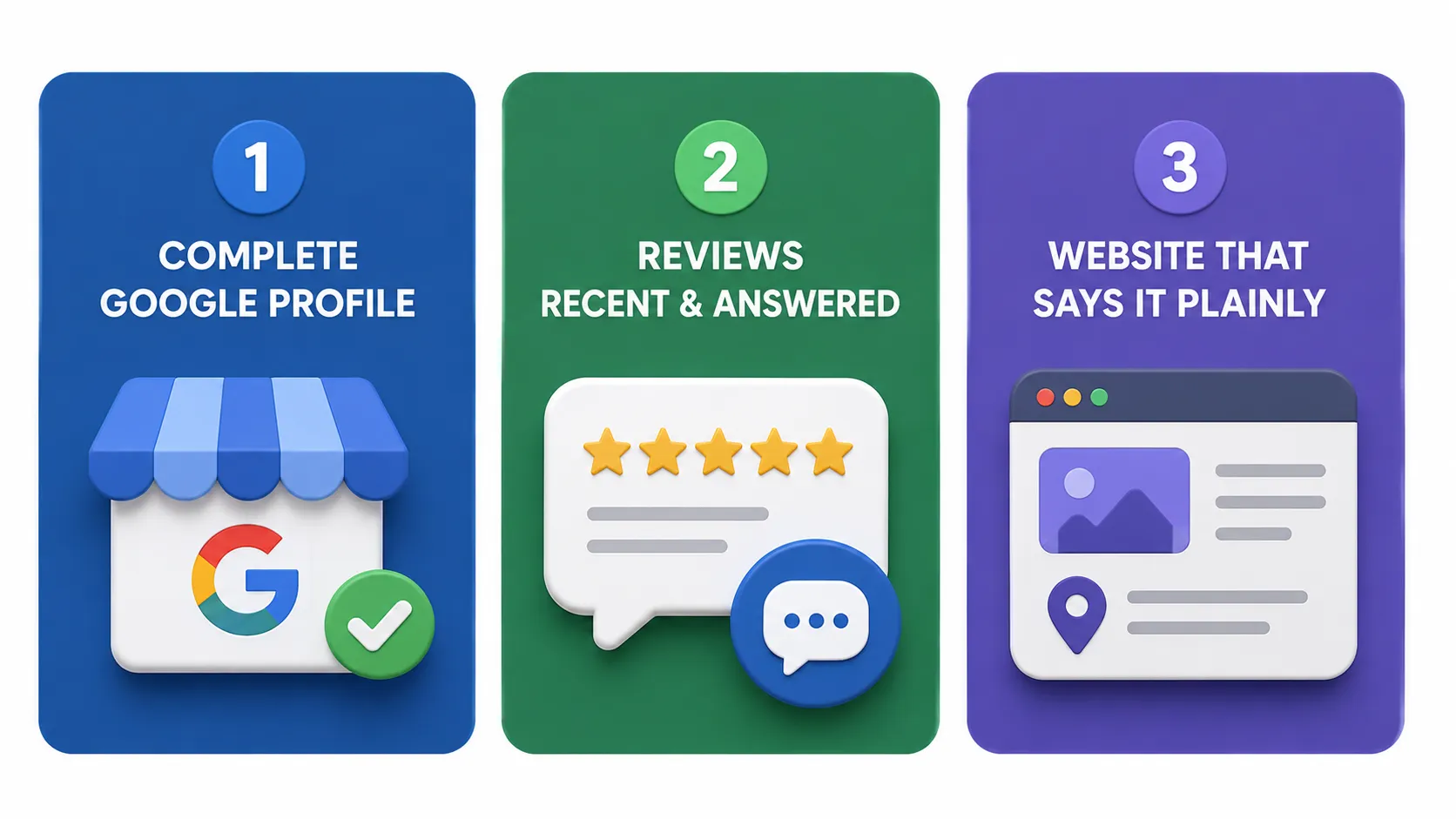
Thing 1: A complete Google Business Profile
Direct answer: your Google profile is your real homepage now — and most of your competitors haven't finished theirs.
Google Business Profile signals account for roughly 32% of local ranking weight — the single biggest factor (Whitespark / BrightLocal ranking studies). And it's the most winnable one, because an estimated 56% of local businesses haven't claimed or fully optimized their profile. Half your competition is forfeiting the biggest lever.
Complete profiles get about 7x more clicks than incomplete ones. Complete means: correct categories, services listed, hours current, photos uploaded, and a real description of what you do. Businesses that post updates weekly see around 28% more clicks — and only 17% of businesses bother posting at all. The bar is on the floor.
Thing 2: Reviews — recent ones, answered
Direct answer: nearly every customer reads your reviews before contacting you, and recency now matters more than volume.
97% of consumers read reviews for local businesses, and 41% now say they always check reviews before choosing — up from 29% a year earlier (BrightLocal, 2026). Review signals also carry about 16% of local ranking weight, so reviews decide both whether Google shows you and whether the customer picks you.
Two details most owners miss. First, recency beats quantity: a business with 30 reviews and three from this month beats one with 200 reviews that stopped two years ago. Second, responses count — an unanswered one-star review says more about you than the review itself. The fix is a habit, not a campaign: ask every happy customer, and reply to everything.
Thing 3: A website that says what you do in plain text
Direct answer: your site has to state your service, your area, and your credibility in words — because both Google and AI assemble answers from your text, not your design.
On-page signals carry roughly 19% of local ranking weight. That doesn't mean technical wizardry — it means your pages literally contain the words people search: the service, the town, the proof. A homepage that says "Welcome to quality you can trust" ranks for nothing, because nobody searches for that.
This matters double now that AI answers local questions. When someone asks ChatGPT or Google's AI "who's the best detailer near me," the recommendation is assembled from plain page text. Vague sites don't get misranked — they get skipped. A page that says "mobile car detailing in Fairfax County, at your driveway, done in 90 minutes" is legible to a human in five seconds, to Google's crawler, and to the AI making the referral. Same fix, three audiences.
How do I check where I stand?
Direct answer: run these three checks — ten minutes total.
Search your own category + town in an incognito window. Are you in the map pack? Who is?
Open your Google Business Profile as a customer would. Missing photos, wrong hours, empty services list — each gap is a click going elsewhere.
Read your homepage's first screen out loud. If it doesn't name your service and your area, neither Google nor a stranger knows what you sell.
Most owners fail at least one check — and fixing all three costs time, not money. The harder part is keeping them maintained while running the actual business, which is exactly the job ProfitJam takes over: a site written to be found, a profile that stays current, and the follow-up that keeps reviews coming — set up once, running weekly. Want us to run your business through these checks? Give us a shout.
FAQ
What matters most for local SEO in 2026?
Google Business Profile signals (~32% of ranking weight), on-page website signals (~19%), and reviews (~16%) are the three biggest factors. Together they decide most of who appears in the local map pack.
How many reviews does a local business need?
There's no magic number, but listings with 50+ reviews and a 4.5+ rating rank in the top three far more often. Recency matters most — steady recent reviews beat a large stale total.
Do I need to pay for ads to show up in local search?
No. The map pack is organic. A complete Google Business Profile, active reviews, and a clear website can put you in the top three without ad spend — which is why the 56% of businesses with unclaimed profiles are leaving free visibility on the table.
Does my website really matter if I have a good Google profile?
Yes. On-page signals carry about a fifth of local ranking weight, and your site is what converts the click into a call. It's also what AI tools read when generating local recommendations.