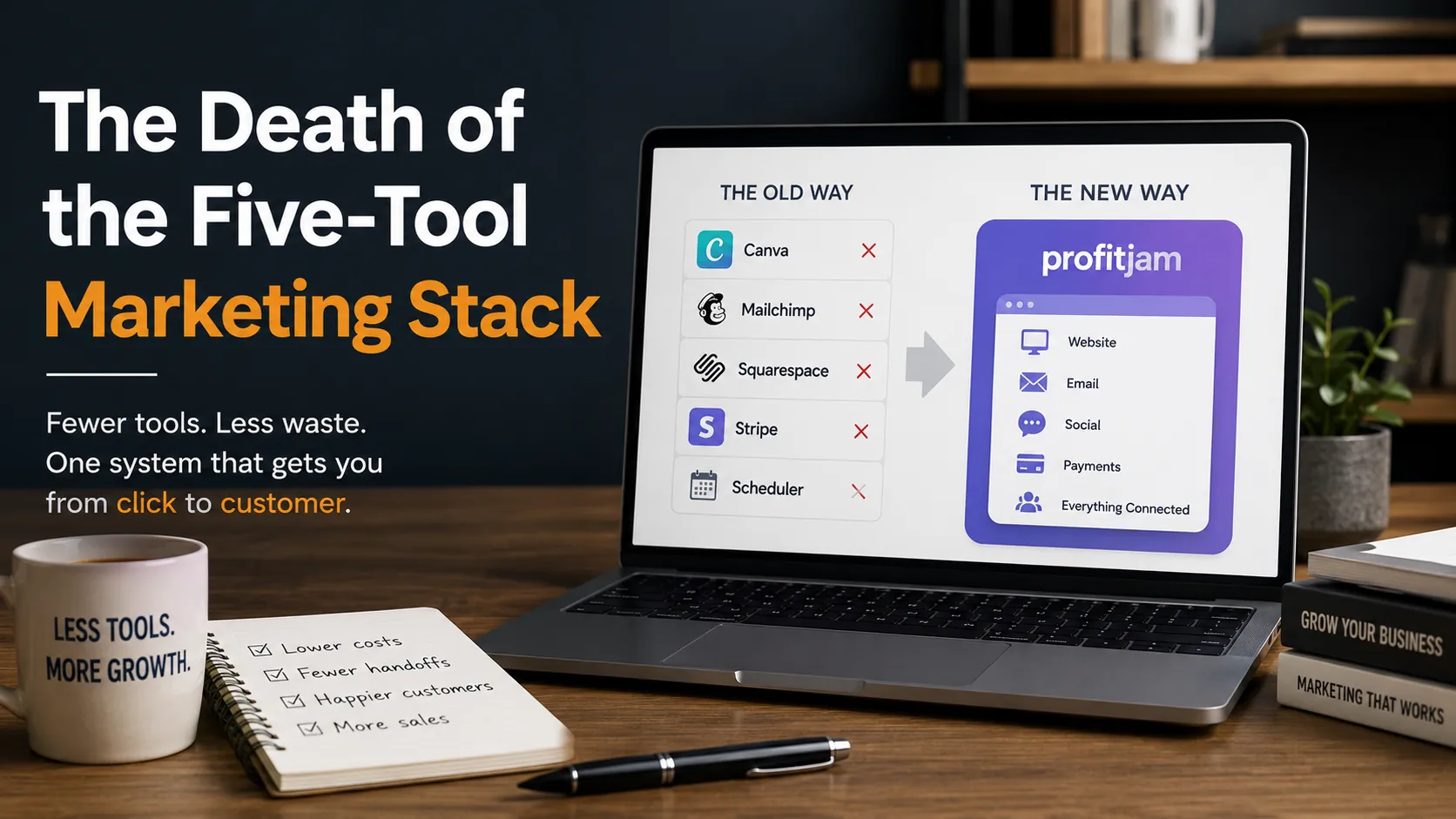
Somewhere along the way, "having your marketing together" came to mean this: Canva for graphics, Mailchimp for email, Squarespace for the site, Stripe for payments, and a scheduler taped across the top. Five logins, five bills, and you — the human middleware — carrying data between them. That arrangement had a good decade. The data says it's ending.
Is the multi-tool stack really dying?
Direct answer: yes — for the first time in the history of SaaS, businesses are cutting tools, not adding them.
After fifteen years of nonstop growth, the average number of SaaS apps per company peaked at 130 in 2022 and has fallen to 106 — an 18% drop in three years (BetterCloud, 2025–2026). This is the second consecutive year of decline, and analysts across the industry describe 2026's defining SaaS trend in one word: consolidation. Fewer tools, more scrutiny at every renewal, and spend concentrating in platforms that can absorb adjacent jobs.
Small businesses were never running 106 apps, but the same pattern holds at their scale: 75% of U.S. small businesses juggle at least two marketing channels, typically with a separate tool per channel — and they're the least equipped to absorb the overhead that creates.
Why is the stack collapsing now?
Direct answer: because the waste finally got measured — half of licenses go unused and the seams between tools leak money.
The numbers behind the consolidation wave: roughly 49% of SaaS licenses go unused, 7 in 10 organizations report overlapping tools doing the same job, and unmanaged software estates waste an estimated 25–30% of total spend (BetterCloud; BCG / Gartner analyses). Businesses spent a decade buying point solutions and are now discovering they bought the same capability three times.
For a small business the waste isn't just licenses — it's the seams. Every gap between tools is a manual handoff: export the leads here, import them there, hope the Zapier connection didn't silently break in March. The five-tool stack doesn't just cost five subscriptions; it costs a part-time integration engineer, and that engineer is you.
What replaces the stack?
Direct answer: platforms organized around the outcome — getting paid — instead of around a feature category.
The tools being cut are the ones that own one step of a customer's journey and hand off the rest. The tools surviving are the ones that close the loop: the same system that publishes the post captures the lead, sends the follow-up, and takes the payment. When the modules share one customer record, the handoffs stop being your job — and the "which tool has the truth?" question disappears.
AI is what makes this viable at small-business scale, because the consolidated platform can now also do the work, not just hold the features. Notably, marketing automation is the one software category where small firms out-adopt large ones (U.S. SBA Office of Advocacy, 2025) — lean teams have the most to gain from tools that execute instead of just enabling.
The old logic was "best tool for each job." The new logic is "fewest seams between the click that finds you and the click that pays you."
How do I know if my stack is due?
Direct answer: run the three-question audit — it takes ten minutes and one bank statement.
Total the bills. Pull one month's statement and add every marketing/website/email/payment subscription. Most owners have never seen the sum.
Count the manual handoffs. Every time you move a contact, a lead, or a piece of content from one tool to another by hand, that's a seam. Seams are where leads leak.
Ask the truth question. If a customer emailed you right now, which tool knows their full history — what they clicked, what they were sent, what they bought? If the answer is "none, I'd check three," your stack is a filing problem pretending to be a system.
Two or more failures means you're paying the fragmentation tax. ProfitJam is built as the after-picture: site, email, social, and payments in one system with one customer record — the stack collapsed into a platform. Want a walkthrough of what your current five tools look like as one? Give us a shout.
FAQ
How many software tools does the average business use?
The average company now uses 106 SaaS applications, down 18% from the 2022 peak of 130 — the first sustained decline on record (BetterCloud). Small businesses run far fewer, but the consolidation trend is the same.
Why are businesses consolidating their software?
Because measured waste caught up with convenience: roughly half of licenses go unused, 7 in 10 companies report redundant tools, and fragmented stacks waste an estimated 25–30% of software spend while creating manual work between systems.
Is an all-in-one platform worse at each individual function?
The fair criticism of older all-in-ones was thin features everywhere. The current generation competes on a different axis: whether every module connects to the same customer record and the same revenue outcome — which point solutions structurally can't do.
What should stay separate from an all-in-one platform?
Anything genuinely specialized to your trade — industry-specific operations software, accounting, compliance tools. The consolidation case is strongest for the marketing-to-payment chain, where the handoffs between tools are exactly where leads are lost.